

With contributions from Cirencester Archaeological & Historical Society, Cirencester Civic Society, members & friends
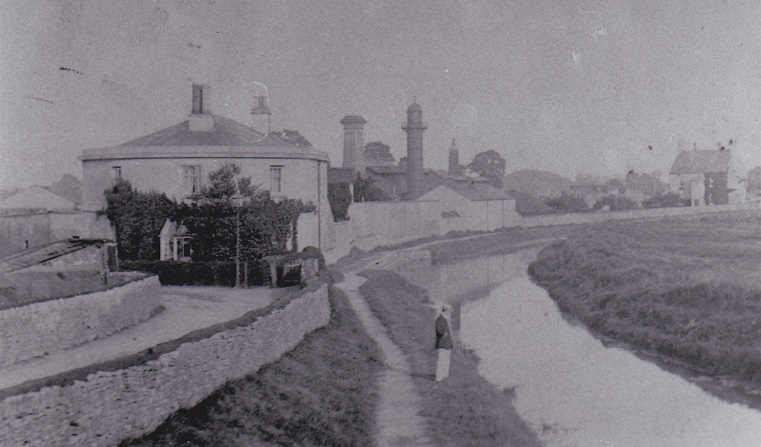
Main photo: Gas House, Canal, Cirencester
This rare photograph from 1907 shows the works squeezed between Gas Lane and Thames & Severn Canal.
Our second look at the area of Watermoor which disappeared beneath the Fire Station roundabout, recently renewed, and the passage of the ring road through the south of the town takes in one particular and important development, which provided Cirencester with its own town gas works.
The Town Improvement Act of 1825 was a very significant step forward for the town, in which the Watermoor area played an important part. This detailed legislation included much by way of change, most notably the clearing away of groups of buildings such as the Shambles occupying what is now our open Market Place. There was also improved street lighting and drainage and the paving of streets. Its influence in the town lasted for much of the Victorian period.
All this came at a cost, funds for some of which came from selling off various plots of land in the Watermoor area. One of these was ‘a certain Common Meadow’ called Kingsmead, a name which has been preserved in much later housing built on this site. The construction shortly afterwards of a gas works, also built on common land, was one of the first most obvious changes in this area.
These gas works, on the appropriately-named Gas Lane (later part of Bridge Road and now referred to as Bridge End) were designed by William Morley Stears, a gas engineer from Leeds. He was a very active contractor, with similar works in Stroud; both opened in 1833, and another at Coleford in the Forest of Dean in 1840.

Both the Cirencester and Stroud works were constructed close to working canals, for the easy supply of coal. Gas Lane ran immediately alongside the Cirencester branch of the Thames & Severn Canal from Siddington Junction. The canal was the initial transport link, although once the Midland & South Western Junction Railway [MSWJR] opened in Cirencester in December 1883 a rail link was made into the gas works for the same purpose.
Gas works were often rather isolated, as here on the edge of town, because of the nature and smells of gas manufacture, achieved by heating coal in retorts to produce ‘coal gas.’ This was condensed and purified in other purpose-built structures in order to remove impurities, and then stored in large telescopic containers known as gasholders before being piped to homes and businesses. By 1885 there were over ten miles of main piping supplying gas around Cirencester, both for street lighting and to business and private premises.
The skyline of any gasworks was largely dominated by the gasholders, and Cirencester had a sequence of these, ever-larger as demand grew. The two original 30ft diameter holders had been supplemented by a 50ft holder by 1854. Within ten years the smaller ones had gone, replaced by a 60ft holder. And in 1885 a total storage capacity of 185,0000 cubic ft of storage was achieved with a new 80ft diameter holder. The works had the space to achieve all this, but nothing of this sequence remains visible now.
What does survive is still of interest. It is best appreciated from the old Gas Lane (via Bridge End at the Chesterton Lane end), still very much an industrial, working environment. Prime position is occupied by the gas manager’s house, originally Gas House (now known as Bridge End House), round-fronted in ashlar stone and a Grade 2 listed building, also dating from 1833.
Just beyond, there is still the original group of buildings fronting Gas Lane, with its angled entrance into the gas-works proper and surviving buildings behind, now heavily refurbished and reduced in acreage by road and other development all round. Today this is Emmervale Court, a small business park.
The largest gas holder and other storage buildings extended the site further south, across what is now Midland Road and the Cirencester Retail Park off Bridge Road. This included the site of the largest of the gasholders, once prominent but now a fading memory as another piece of Cirencester history.
The gas industry was nationalised in 1949 and together with conversion to natural gas from 1967 brought to an end the old ways of gas manufacture, and with it the clearance of buildings by then of no more than historic interest. Nationally, only two historic town gasworks sites survive and can be visited in anything like their recognisable state: Fakenham in Norfolk and Biggar in the Scottish Borders. A third at Carrickfergus in Northern Ireland has recently been mothballed with an uncertain future.
David Viner
Support Cirencester’s principal heritage societies and their event programmes: Archaeological & Historical Society (www.cirenhistory.org.uk) and Civic Society (www.ccsoc.org.uk), which runs a programme of Town Walks in the season plus pre-booked for small groups. Please contact Rob Tuttle: townwalks@cirencestercivicsociety.org – tel. 07771-998182
To keep up to date with what´s going on in town, feel free to join our Facebook group by clicking here. To advertise with the magazine check out the Rates & Media Pack – Ciren Scene!
0 comments on “CAHS Snapshots of Local History: Gas Lights Up Cirencester”