


With contributions from Cirencester Archaeological & Historical Society, Cirencester Civic Society, members & friends.
The supply of water, whether too much (flooding) or too little (shortages etc) seems always to be in the news and likely to keep its high public profile in the future as demand rises and climate change takes its toll. It is a big political issue.
Maintaining public drinking water supplies is only part of this wider picture, but a vital one. A little booklet which recently came my way courtesy of Martin Edwards of Cirencester records a key stage in this story locally when new facilities were unveiled by Cirencester Urban District Council, as the local Water Authority, at its Baunton Pumping Station in October 1956.
The long back-story to this includes much of Cirencester’s dwellings (as they were called) relying on back-yard wells for their water supply, with all the associated risks of infection and disease. Only in the later 19th century with the creation of the UDC were serious efforts made to ‘ensure the provision of an ample and wholesome supply of water’ to meet the community’s ever-growing needs.
The first step was the creation of Cirencester Waterworks Company in 1882 for the purpose of converting the Cirencester Brewery Company premises in Lewis Lane into a water works. The brewery buildings occupied the corner site with Watermoor Road and had the benefit of two deep wells with considerable capacity; one yielded 4,200 gallons per hour, the other deeper well some 9,000 gallons per hour.

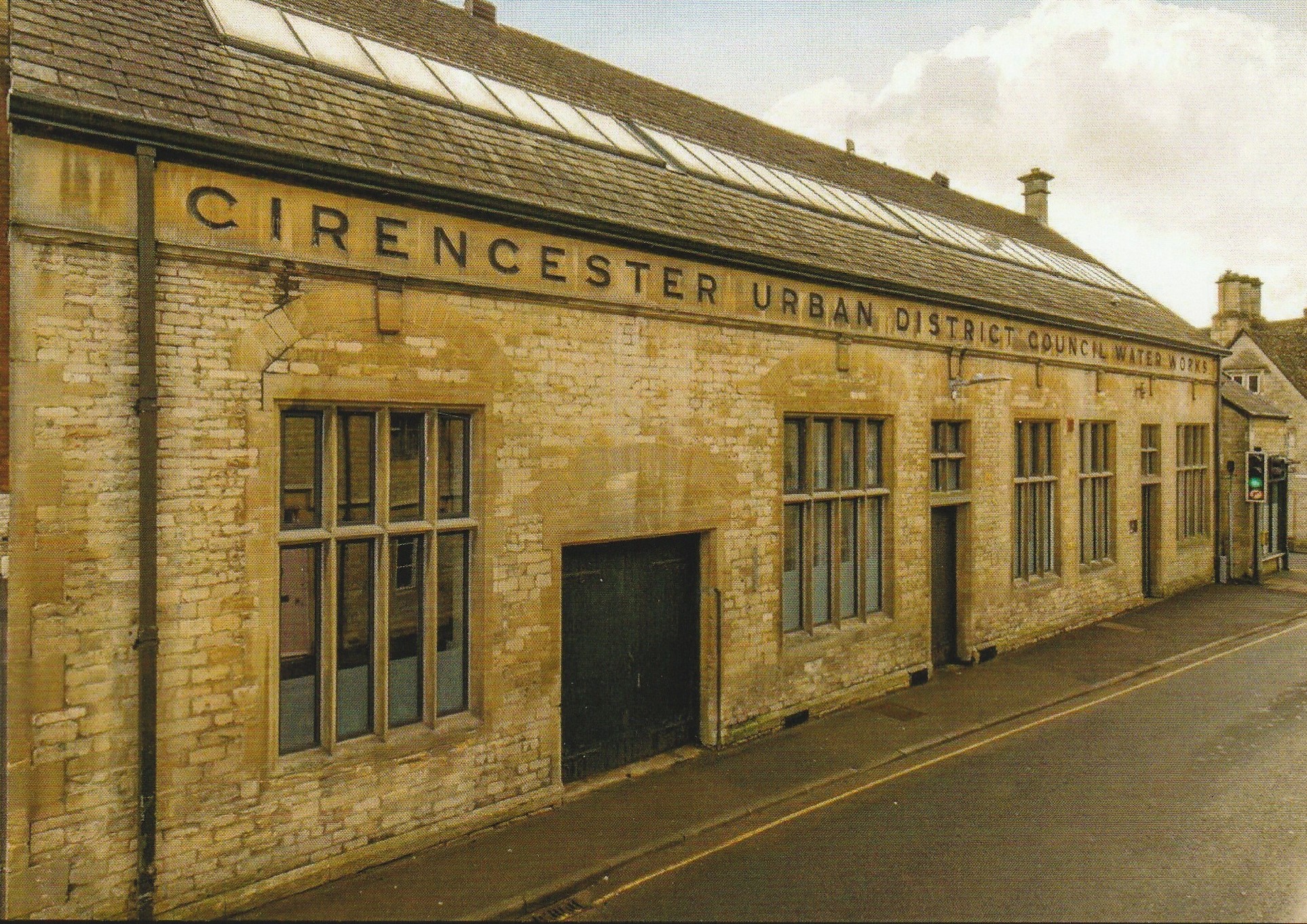
In 1891 & 1897 the Council officially became the statutory authority to maintain this function together with the service reservoir housed alongside the Ewe Pens road in Cirencester Park. This responsibility covered Cirencester UDC, Stratton parish and Coates. The rather severe frontage of the heavily labelled ‘Cirencester Urban District Council Water Works’ building in Lewis Lane dates from this period.
From then on, the story is of periodic improvements, intended to upgrade equipment and especially to increase capacity for the growing town population, including sinking further and deeper wells and updating pumping capacity. By 1910 an average daily output of 89,000 gallons served an 8,347 local population. Re-equipping with new pumps into deeper borings in 1925/6 produced some 129,000 gallons per day.
The next stage was reached in the 1930s when stimulated by some slight pollution in the water supply from this town-centre site, ever-increasing demand and the consequent diminution of water pressure the decision was taken to purchase the Baunton site in the Churn valley and provide a new and larger service reservoir off the Gloucester road, two miles from town. Both continue in use today, the Lewis Lane water works having been closed and the wells plated over.
The new station was completed in 1938 at a cost of £26,160. An 8-inch diameter rising main was laid from the new pump house to the newly constructed covered concrete service reservoir, itself an impressive structure capable of 250,000 gallons storage capacity to a depth of 10 feet. From it a 10-inch delivery main ran via Gloucester Road, Abbey Way, Grove Lane, and London Road, where it connected with the existing mains system.
In these immediate pre-war years and in addition to serving the town, bulk water supplies could be made available to Cirencester Rural District Council to include South Cerney Airfield, Preston, Harnhill, Driffield, Siddington and Baunton. By 1939 the rapid rise in demand due to evacuees and dispersed war workers raised the local population to c.12,000.
The celebratory booklet records the upgrading and extensions made in the mid-1950s, including additional reservoir capacity, capable of distributing over 600,000 gallons per day, of which interestingly the bulk supply to ‘South Cerney Airfield’ absorbed 80,000 gallons. It would be interesting to know whether Air Ministry funding may have assisted or stimulated this upgrading with that in mind?
J.W. (Jack) Elliott, the Council’s Surveyor & Water Engineer, compiled the booklet, no doubt aided by the rich source of reference material now preserved in the Gloucestershire Archives. The subject of water and its safe supply to the community also seems to be a favourite study or dissertation project for local students. Meanwhile the physical network described here remains the basis of today’s water provision into and around the town.
David & Linda Viner
For the booklet, see Glos Archives ref no GA, D10820 G1-1-n.
Support Cirencester’s principal heritage societies and their event programmes: Archaeological & Historical Society (www.cirenhistory.org.uk) and Civic Society (www.ccsoc.org.uk), which runs a programme of Town Walks in the season plus pre-booked for small groups. See the Society’s website or email Rob Tuttle: info@townwalkscirencester.uk or robtuttle@btinternet.com
To keep up to date with what´s going on in town, feel free to join our Facebook group by clicking here. To advertise with the magazine check out the Rates & Media Pack – Ciren Scene!
Very interesting, thank you
Pingback: CAHS Snapshots of Local History 2025 – Ciren Scene