

Snapshots of Local History
With contributions from Cirencester Archaeological & Historical Society, Cirencester Civic Society, members & friends
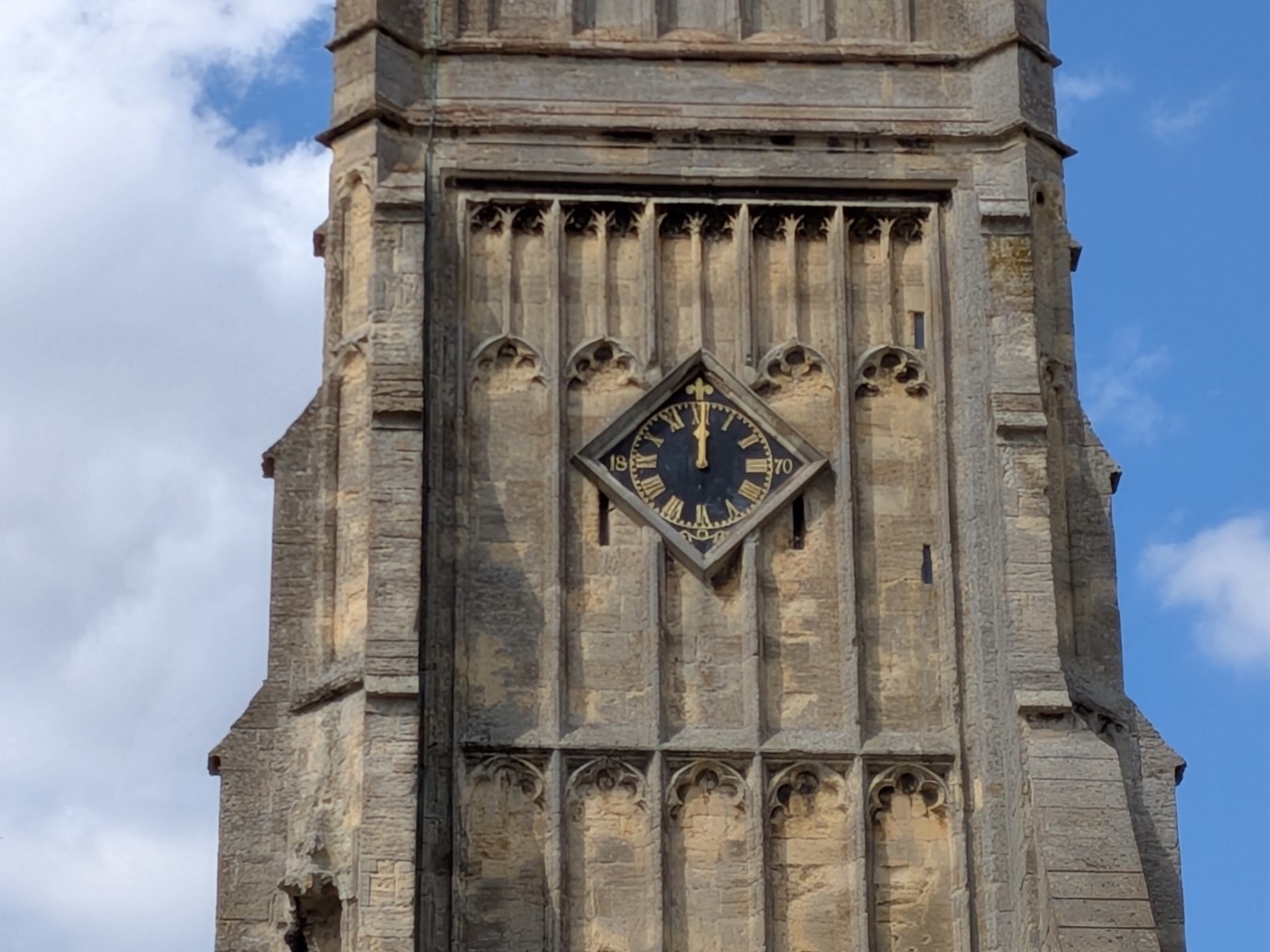
We might wonder how many thousands (millions, probably) of pairs of eyes have glanced up to the tower of Cirencester parish church over the years to check on the time? It’s a natural process, although much less essential now that we all have so many other ways of accessing the time. Watches, smart phones and other gismos are all easily to hand.
The church tower is by far Cirencester’s most impressive upstanding monument of course, and it is graced by a fine clock face on both north and south sides, facing into the Market Place and towards Gosditch and Dollar Streets. It is also clearly dated to 1870, the key year of its restoration. There have been other campaigns since then, most recently in the 1980s when Cirencester Society in London sponsored the re-gilding of the clock faces as part of a general overhaul of the clock mechanism.

The predecessor clock and mechanism was late medieval in date and in poor condition, described in a letter to the Standard in February 1868 as ‘the abominable machine called a clock’. The comprehensive overhaul of 1870 was largely funded by public subscription.
Checking the time is also linked to the other regular processes housed in the tower, offering regular time checks for those in the know or who quickly recognise the sequences. The Quarter Chimes throughout the day are an integral part of town life.
The clock is doubly important as it has a contemporary carillon, or tune player, a separate mechanism which is housed in the tower above the clock chamber. This too is historically significant equipment, playing an old Psalm tune (the 113th).
An article in the Parish Magazine in August 1951 summarised this story, concluding that the townspeople “should be proud of our fine clock and the farsighted folk who bought the best available over eighty years ago, providing us with a clock that will give constant service for many years to come”. Indeed it has.
In past times, there were more clocks in public buildings in the town than the few which survive today. The hospital in Sheep Street, nearby Town railway station, the library in Dyer Street, various council and utility offices and some of the major inns would all have had one. Few if any do so now, in quite the same way – the need is no longer there.
Shops had clocks too, inside and some outside, of which at least a couple can still be found. Best known because of its central location in the Market Place is the still-working Stradling clock, its blue face inscribed A Stradling Maker Cirencester. It dates from or around 1887 when the business was established by Alfred Stradling in West Market Place before the widening of Castle Street in 1897 enforced removal to its present central location. Here the business expanded over time, acquiring adjoining shops (Gifford & Groves and then Walter Hawes) in 1964 and 1973. The façade has been developed again since then, but the clock is a reminder of a well-known town business in clocks, watches and jewellery.

There is often a strong connection between these various trades, originating or growing as family businesses trading in market towns like Cirencester.
Around the corner in West Market Place (above Fat Face and Oxfam) but sadly presented rather less well is a reminder of another such business with a long pedigree in the town. The hanging clock survives above what was Leonard Jones, which celebrated its Golden Jubilee in 1974 (established in 1924). As a young man, Jones acquired the jewellery business of W.C. Bartlett on this site and grew it from there.
There are other links between clocks too. The Strange family in Cirencester has memories of Edward Strange (born in Coxwell Street in 1928) who as an apprentice at Stradlings had the Saturday morning duty of climbing the church tower to wind up the heavy weights that drove the clockworks. He went on to develop his own horological business elsewhere.
A number of other Cirencester-made clocks survive from the 18th and 19th centuries including so-called tavern and long-case clocks. A fine example made in the town by James Skipton dates from the mid-19th century and is preserved in the old town hall in the church south porch. Like others which remain in private hands it may not be easily accessible but is very much part of Cirencester’s contribution to horology.
Linda & David Viner
Support Cirencester’s principal heritage societies and their event programmes: Archaeological & Historical Society (www.cirenhistory.org.uk) and Civic Society (www.ccsoc.org.uk), which runs a programme of Town Walks in the season plus pre-booked for small groups. Please contact Rob Tuttle: townwalks@cirencestercivicsociety.org – tel. 07771-998182
To keep up to date with what´s going on in town, feel free to join our Facebook group by clicking here. To advertise with the magazine check out the Rates & Media Pack – Ciren Scene!
0 comments on “CAHS Snapshots: Telling the Time in Cirencester”