

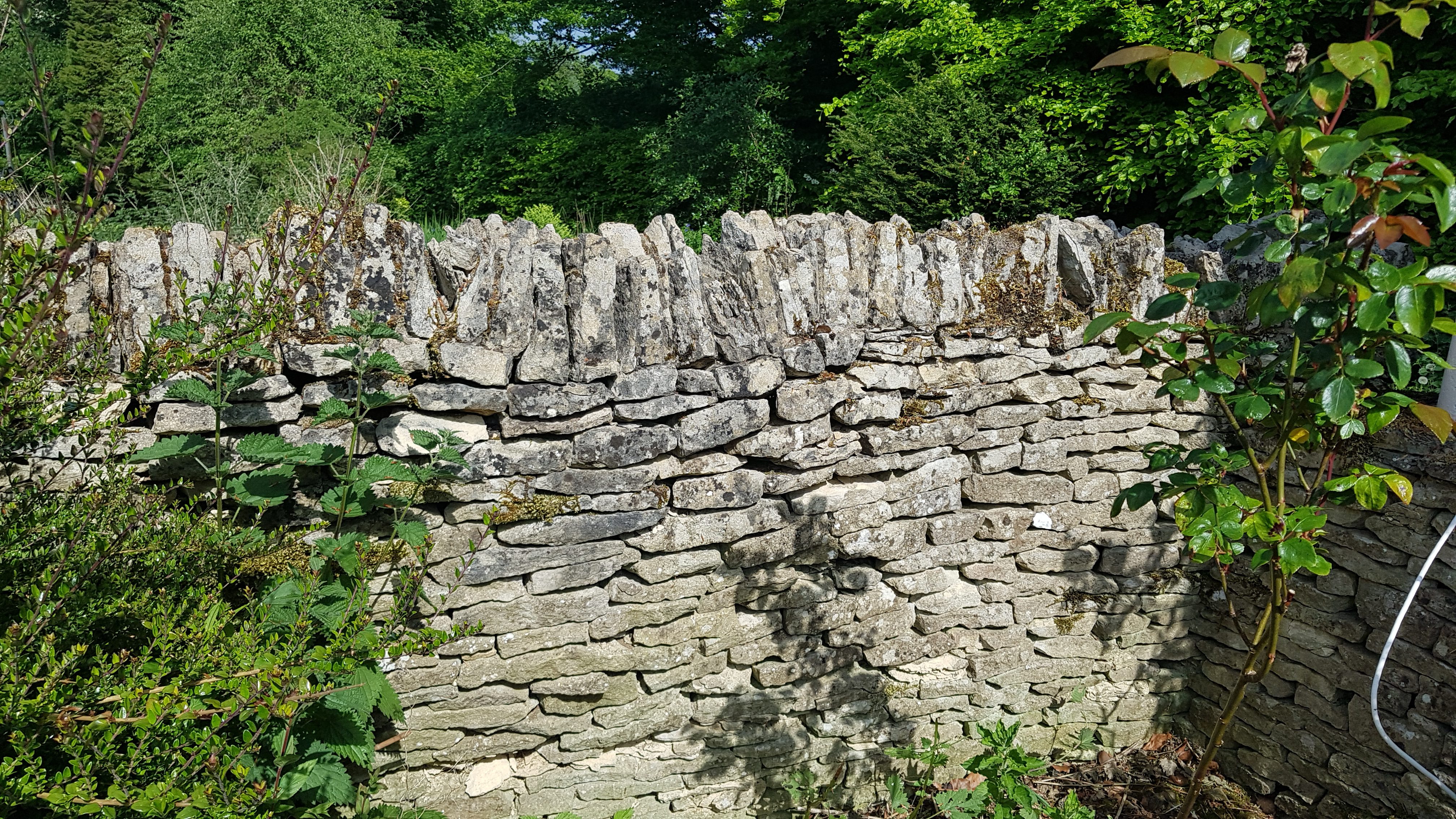
One of the features of the Cotswold landscape is the numerous drystone walls, both ancient and newly built, forming field and property boundaries, and even demarcating the routes of highways.
Twelve skilled craftsman stonemasons have been trained for National Highways to construct a Cotswold limestone wall beside the A417 ‘Missing Link’ which will extend for seven and a half kilometres (about four miles) by the sides of the new section of road overcoming the former traffic bottleneck passing the site of the old Air Balloon pub near Birdlip. They’ve been building a metre a day for over a year and expect to finish by 2027.
Making one of the newest drystone walls in Britain, it uses techniques dating back more than 3,500 years – as seen at Skara Brae in Orkney, Scotland. Although there are similarities between those ancient walls and today’s construction methods, there are many local variations according to the types of stone used and differing traditions amongst the artisans who have carried out this work over the centuries. It’s quite difficult to date dry stone walls, and one of the most reliable methods is the scientific use of ‘rock surface luminescence’, which can determine how long the surface of the stone has been exposed to the air since the wall was constructed, although any disturbance for maintenance will confuse the result.
In the UK, the Dry Stone Walling Association (DSWA) has a broad membership of craftspeople who work with various types of stone from rubble found in fields and flint, through limestone, sandstone, slate and granite, and the ‘purists’ among them do not use mortar, principally because the problem arises when mortar prevents the stones from flexing in response to the effects of weather and climate change which can lead to movement in the ground upon which the walls are built. Because granite is more inclined to be rounded than other materials, wallers in Devon and Cornwall, parts of Scotland and Wales, in Shropshire and Leicestershire, sometimes use earth and small stones to fill internal spaces in walls, much as random-rubble walls in houses incorporate loose chippings in the central core of walls with rendered outer skins.
Equally, dry stone walls do not have level concrete foundations such as used by brick and block-built walls, because this would make the structures far more likely to collapse when frost and floods undermine their environment – something we see demonstrated by the tendency of water mains to fracture when they fall into voids caused by drought shrinking the ground beneath them. It’s like the old song said: “the concrete and the clay beneath my feet begin to crumble.” Dry stone walls are more reminiscent of Gershwin’s; “in time the Rockies may tumble, Gibraltar may crumble – they’re only made of clay” but our walls are here to stay. Careful selection of rough shaped stones fits together like jigsaw pieces, holding together by the friction of geometric locks
If you’re anything like the Arrowsmith household, you may be surrounded by Cotswold limestone walls and have seen how certain types of locally quarried stone can split into layers and fall apart when heavy frosts occur. That’s when, in theory, you might wish local authorities had the funds to offer grants for the maintenance and repair of walls in Areas of Outstanding Natural Beauty, but woe betide you if you try to demolish a crumbling wall without first consulting the relevant powers! A new or replacement section of professionally built dry stone wall can cost around £250 a square metre! Inspiringly though, it could stand for more than three thousand years as your memorial.
To keep up to date with what´s going on in town, feel free to join our Facebook group by clicking here. To advertise with the magazine check out the Rates & Media Pack – Ciren Scene!
I think walling in your blood . I have been a dry stone Waller for 20year based in Cirencester in the heat of the Cotswolds .Its really is a massive change to do this kind of work it has to be a passion for every waller