

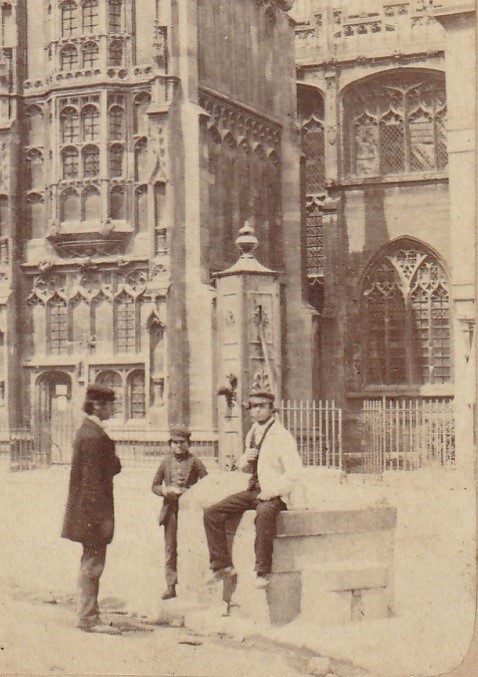
Image above: The many uses of the Town Pump (courtesy Eddie Cuss collection).
Coleridge’s Ancient Mariner cried out: ‘Water, water, everywhere but not a drop to drink’. Over the last few months it is possible to feel that we have had more than enough to repair the ravages of last summer’s drought with its hose pipe bans and parched lawns.
But clean, drinking water, at the right time and in the right place, is a necessity – achieved with a simple turn of the tap.
In 1800 Samuel Rudder was able to report: ‘The [town’s] water is sweet and pleasant, rising out of a fine gravel, from about fifteen to twenty feet below the surface, and almost every house has a pump. So great a plenty of this necessary element conduces much to cleanliness and is in some degree a security against the ravages of fire, from which no town has more providentially escaped.’

The 1825 Town Improvement Act led to the clearance of houses creating the broad open market place which we enjoy today. Until the opening of the Cirencester Urban District Council Waterworks in Lewis Lane in 1882, the town’s residents and businesses relied on wells or watercourses for water, carried in pails and buckets. If you were lucky you had your own well, if not you shared with others in the street or close.
In 1840 a well was sunk in the market place, and a Public Pump installed. Professor Allen Harker later confirmed the ‘depth of the well as being 25 to 26ft; after passing through 7-8ft of made ground there is about 20ft of gravel (which holds the water) resting on thick beds of impervious clays.’
Over the decades the pump has had various manifestations and embellishments. A drinking fountain was added in 1859, and all activity was lit by lamps.
Its central location ensured it soon became the focus for activity and not just for collecting water: the town crier declaiming to large crowds and causing an obstruction; political hustings where candidates, metaphorically, could pour cold water on their opponents; as the centre of celebrations, decorated to mark the return of Earl and Countess Bathurst after their honeymoon in 1893; and bunting for the visit by HRH Prince of Wales in 1895.
But function was key: water for private houses and commercial properties; a reliable source of water to enable the Fire Brigade to fill their water carriers in response to fires; for the local authority to fill their water barrels to dampen the dust in the streets; and drinking water for humans, horses and dogs.
Prior to 1867 and the opening of a purpose-built Cattle Market in Tetbury Road, the Market Place was just that – on market days busy with farmers trading cattle and sheep, and waggons of grain and other produce. Part of the selling and buying of goods relied on the reliable weighing of produce and commodities to ensure a fair price.
Early maps show the location of a weighing machine in the street between The Waterloo Passage and the former Sun Inn . But adjoining businesses complained of the damage done to their shop blinds as the machine raised and lowered fully laden waggons.

Later photographs show the large metal plate of the weighing machine in its new location in 1894 to the north of the pump. But as council reports show this was not the ideal relocation, with complaints that the weighing mechanism was a hindrance reducing access to the pump; and water leakage from the well, settling in the bottom of the pit, froze in winter and upset the balance.
On a lighter note: in 1914 a former Powell School pupil recalled the local tradition that on Shrove Tuesday, when the “Pancake Bell” was rung at 12 o’clock, the Town Pump hearing the bell started on a perambulation of the streets. ‘The children used to run to the Market Place to view the startling spectacle, but as they did not leave school till after the hour of noon, they always found when they reached the Market Place that the Pump had sedately returned to its stationary position.’
It was finally removed in 1935 to free up space for one car, and its site was obscured by car parking ever since. But the more recent and welcome creation of a large open public space in front of the church included a marking of the location of the pump’s well site with an accompanying nearby plaque – close to one of the two stone pedestals. Seek it out, but preferably avoiding busy market days!
Linda & David Viner
To keep up to date with what´s going on in town, feel free to join our Facebook group by clicking here. To advertise with the magazine check out the Rates & Media Pack – Ciren Scene!
0 comments on “CAHS Snapshots Apr 26: Cirencester´s Town Pump in the Market Place”