


With contributions from Cirencester Archaeological & Historical Society, members & friends
Historic Cirencester bank closes, part of a national pattern of change
When the Cirencester branch of HSBC Bank closes its doors on 08 August 2023 it marks an end to over a century of banking provision at this location in the very centre of town. This closure, one of many across the nation during 2023, is all part of a national trend towards web-based banking, changing the way people manage their business and with it an end to over-the-counter service as the norm.

HSBC is of course not the only UK-wide bank implementing these changes but having announced last autumn that 114 of its branches would be closing, it has been busy doing just that this summer with closures every month from May to August, among them Stroud in May and now Cirencester.
The building’s location on the corner of the Market Place at the top of Cricklade Street (postal address no 2 Market Place) is about as prominent a position as one could find. This is not happenchance, as the search for suitable corner-sites seems to have been embedded in the company’s plans for new buildings during the years before the First World War.
This was before HSBC of course and many local people will still remember this as the Midland Bank, with its slogan as ‘the listening bank’. HSBC’s acquisition in 1992 was one of the then biggest deals in banking history and re-branding was completed in 1999. The Midland Bank first opened for business in Birmingham in 1836 and was naturally strong across central England but it also developed a presence south and west into this part of the world.

In the early 20th century, it was growing its branch network. Corner sites were a favourite it seems for the company’s chief architect, Thomas Bostock Whinney (1860-1926) and there are a number of close look-alikes of his work surviving from this period. For Cirencester Whinney teamed up with local architect V.A. Lawson as his associate, whose work around the town was prominent then and remains so today.
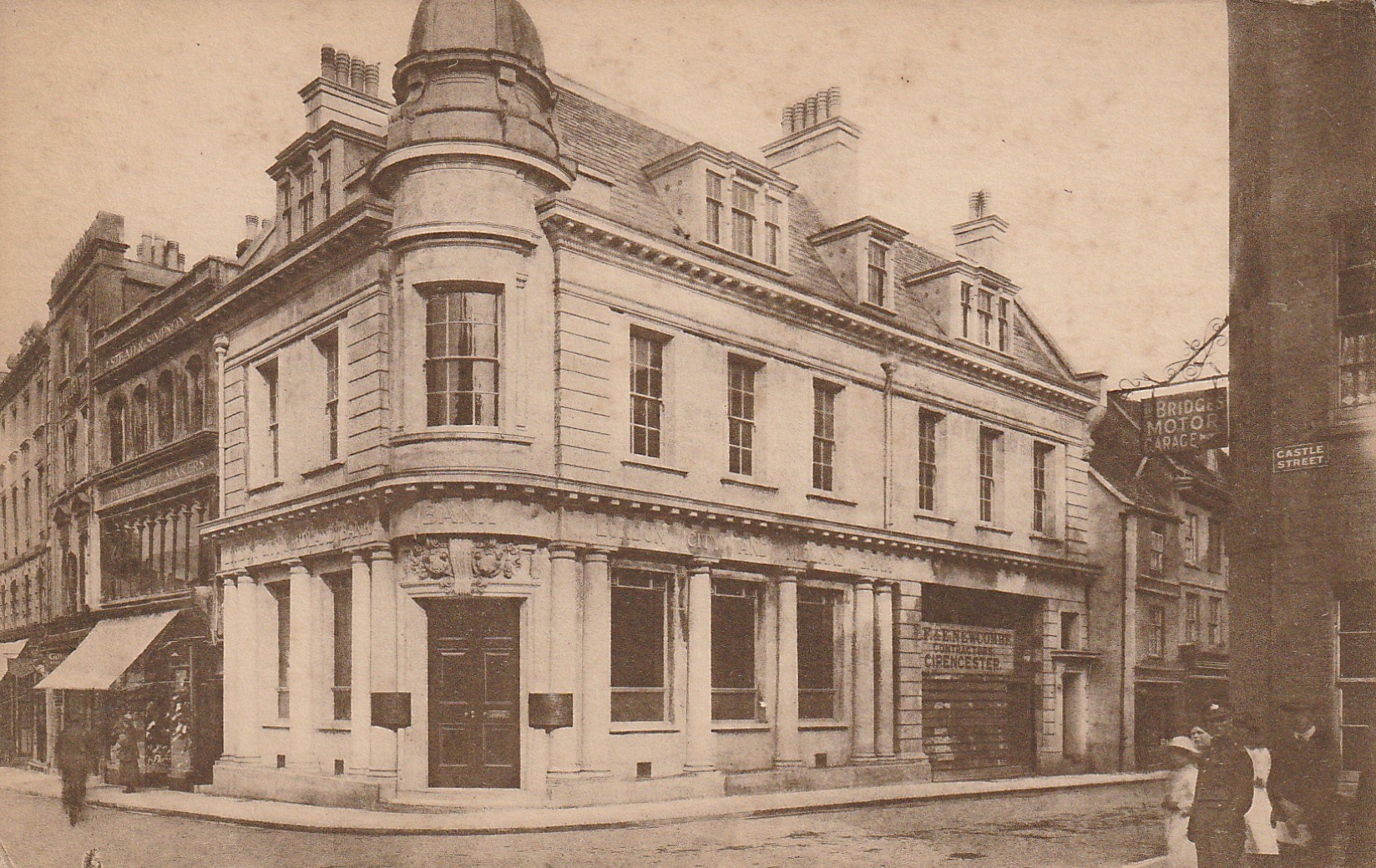
Cirencester photographer W. Dennis Moss was well-placed from his studio in Castle Street to record the changes, and in 1915-16 he captured this ‘top of the town’ scene in several images in his Cecily Series. This record is especially valuable in that it not only records the brand-new bank but also shows the old buildings on the site prior to demolition. And what a fine group they were!
The most obvious was the corner shop of Bishop Brothers, family grocers, tea dealers and wine and spirit merchants. This building was clearly a timber-framed structure with its overhang above the ground floor and enormous gable-end to the Market Place. It would now be regarded as a great loss from Cirencester’s stock of almost certainly 17th century (maybe earlier) timber buildings, but at the time was conveniently regarded as time-expired in its usefulness. Its removal also allowed the top end of Cricklade Street to be ‘thrown back some five yards from the present line’ as reported in the local newspaper.
Also removed was the former J.J. Boulton drapers’ shop, where the photograph shows demolition work getting underway. A large sign on its façade proclaimed ‘Site of the new premises of the London City & Midland Bank Ltd’ with its Head Office at 5 Threadneedle Street [London] EC. Intended customers were invited to ‘Temporary offices at 4 Black Jack Street’. So, a significant town centre rebuilding was underway.
What replaced these was a statement building strong on the new bank’s Edwardian Baroque style, and fashionable of its time, but devoid of any conformity with traditional Cotswold building style or materials. It was clearly different, its most striking feature being constructed in Portland stone ashlar, the town’s only example.
The roof was of Delabole slate; it boasted a circular corner turret (another of the bank’s signature features) and had its longer elevation to Cricklade Street rather than to the Market Place. There are several close parallels of ex-Midland banks with these or similar features: at The Cross in Gloucester (nos 1-3 Northgate Street) which dates from 1905-07, and until recently in Yeovil (no 1 Middle Street) and in Stroud (no 4 King Street).
Externally, Cirencester’s example remains pretty much unaltered over a century later and it will be fascinating to see what new use can be made of it after such a long period as a purpose-built town-centre bank.
David Viner
If you can track down a copy, try Midland: 150 Years of Banking History by A.R. Holmes and Edwin Green (1986).
See also: https://www.about.hsbc.co.uk/hsbc-uk/history-timeline
Support Cirencester’s principal heritage societies and their event programmes: Archaeological & Historical Society (www.cirenhistory.org.uk) and Civic Society (www.ccsoc.org.uk), which runs a programme of Town Walks in the season plus pre-booked for small groups. See the Society’s website or phone William Cooper on 01285 88 55 90.
To keep up to date with what´s going on in town, feel free to join our Facebook group by clicking here.
An excellent article David. I inadvertently put a picture of a charabanc with the Tingle family of Stratton on “Old Cirencester” saying it was Lloyds, now reversed.