

Snapshots of Local History
With contributions from Cirencester Archaeological & Historical Society, Cirencester Civic Society, members & friends
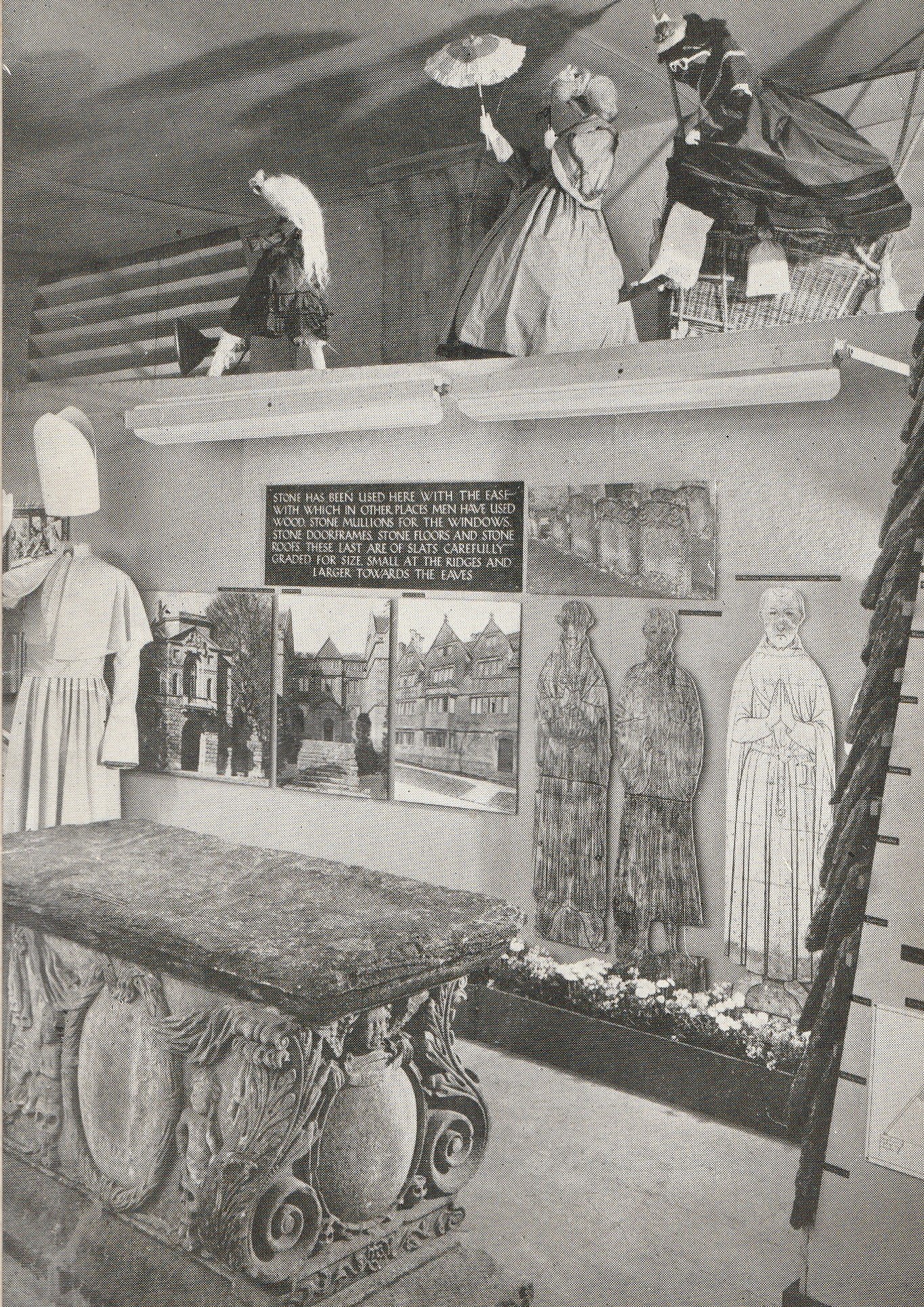
Picture above: The Cotswold Stone exhibit
In Tetbury Road the old Corinium Museum, not in use as such since 1938, found a fresh role for itself as part of the 1951 Festival of Britain.
The Festival was the post-war Labour government’s project to promote the country and provide our tired nation with a tonic. It was planned to be the autobiography of a nation – illustrating the British contribution to civilisation, past, present and future in arts, science and technology, and industrial design.

The Festival tried to encourage every community to be involved to promote civic pride and improvement: “It is hoped that every town and village will share in the Festival by contributing its own festivities in ways most suited to itself”.
In Cirencester, we went beyond a tidy-up of amenities. There would be an exhibition to rival any city. It was to be called ‘The Cotswold Tradition’ and would foster a true appreciation of local heritage by the public, but especially the young.
A committee was formed in 1949, consisting of Earl Bathurst and his mother Lady Viola Apsley; with the Lloyds Bank manager, Mr Garrett, acting as treasurer, along with noted businessman and councillor John Jefferies, Mrs Enid Airy, and Mr Anderson. The exhibitions designer and director was Mr Oliver Hill, a celebrated architect and Sapperton resident. John Betjeman was responsible for the exhibition captions.
Planning began and the Minutes from the committee meetings are surprisingly illuminating in places – characters begin to appear. The committee tackled such mundane things as the need for a marquee for teas, and practical things like recruiting a dry-stone waller from Nympsfield. Other details were very much of their time, for example staffing the exhibition, ‘perhaps ex-service people’ as it was very important to have someone able to give the correct change; or post-war shortages and expense of good white paper for the exhibition catalogue. Mr Hill However thought good paper was essential even with the additional cost.

The ‘Cotswold Tradition’ was opened at 3pm on Thursday 24 May 1951 by the Duchess of Beaufort. As visitors approached they were greeted by Venetian Masts and bunting all along Tetbury Road, Castle Street and the Market Place.
Entering the old museum revealed the most lavish of displays. These were themed as Stone, Wool and Agriculture. Photographs promoted Cotswold stone from prehistoric sites like Belas Knap to medieval churches and wool merchants’ houses. Displays of stone masons’ tools linked with a large dry-stone wall made for the exhibition. The wool section as you might expect laid out the history of wool in the Cotswolds: from Romano-British evidence of fulling at Chedworth to the wool churches of Northleach and Chipping Campden.
There was a large wicker hand suspended from the full height of the ceiling with swags of locally made cloth used to make military uniforms, hunting pinks, and papal robes. In display cases were placed the tools of the trade, pattern books, shears, teasel knife, wool weights, alongside a copy of the Cirencester Weaver’s Company charter.
The Agriculture section focussed on the eighteenth century onward with displays of a barley hummeler, sickles, bill hooks, smocks, cider costrels, butter churns, a bee skep, drawings of wagons, cart horse martingales, a hedgers maul, rick finials and corn dollies, and bonnets.
Being a Cotswold exhibition there were also displays of objects from the Arts & Crafts movement borrowed from local notables, including Gimson candlesticks and a Simmonds carving. There were 7 cases of historical exhibits – with loans from Queen Mary, Captain Spencer-Churchill, W Chester-Master, Lord Vestey, the Duchess of Beaufort, the Pitt Family, Gloucester Museum and of course the Corinium Museum.
Visitor options also included an outside display of waggons and exhibits of basketry, spinning, beehives, and weaving. Then the opportunity to visit Cirencester mansion and view the smoking room, drawing room, annexe, library, large dining room and front hall – in which you could amongst other things see four Van Dykes and two Gainsboroughs, and a chair used by Oliver Cromwell.
Praise was lavished on the exhibition: from architectural writer Christopher Hussey in Country Life – “Cirencester’s compact but brilliantly displayed exhibition”, to the Festival’s director Sir Gerald Barry who “proclaimed on the BBC that it was the best Festival effort outside London.”
Despite all this and the 43,500 people who visited over the five months, the final accounts of this ambitious exhibition did not make for happy reading. Total receipts were
£2,446.69.1d but total expenditure was £5,973.15.8d.
Dr Caroline Morris, Corinium Museum
To keep up to date with what´s going on in town, feel free to join our Facebook group by clicking here. To advertise with the magazine check out the Rates & Media Pack – Ciren Scene!
0 comments on “CAHS Snapshots: The Cotswold Tradition Exhibition of 1951 in Cirencester”