

Just as modern cities can be recognised from their skylines, the horizons and contours of our countryside regions are often as characteristic as our local dialects. The familiar colours of the earth of freshly ploughed fields, the stone and brick of rural barns and houses, even the scent of the ground itself, can mean home to returning travellers. It’s odd that we tend not to notice the view we have of our everyday surroundings until features we have always assumed would never change disappear.
Looking around the Cotswolds it is only when we see red-brick buildings with Welsh slate roofs that we recognise the changes brought about by the arrival of the industrial revolution, which replaced village traditions with styles common beyond the region. This did not always suit local conditions, and it’s particularly noticeable in the case of the materials and the design of roofs.
If we had adopted the style of roofing introduced by the Roman army of occupation to Cirencester, we’d probably have ended up with a closer resemblance to the Provence area of France, our ‘honey-coloured’ stone walls surmounted with terracotta pantiles, laid with a shallow pitch. But that is less suitable here, given the Cotswold tendency towards more rain and snowfall than the South of France.
It’s likely that, after the Romans left, it would have been common to thatch roofs using long-stemmed wheat-straw, and experience would have encouraged builders to set the pitches of roofs at between fifty and fifty-five degrees, to encourage snow to slide off the roof when it built up towards critical loads.
For wealthier residents a more durable option was to use Cotswold stone ‘slates’, such as that quarried near Stow on the Wold, which was hung on the laths with oak pegs, and was often set at a pitch closer to sixty degrees, which led to rooflines which create an appearance of steeper and taller proportions than are seen in other parts of the country.
Stone slates are quarried from the sedimentary limestone which lends itself to being separated into durable thin layers, which is found in a type of the stone called oolitic limestone which resembles deposits of small spherical egg-like particles which look a little like fish-roe or caviar. They are found on the roofs of buildings from the humble cottages at Arlington Row in Bibury to many of the homes of Wealthy landowners.
The Cotswold District Council local design plan, part of the local plan 2011-2031, gives detailed advice concerning the way modern buildings can be styled to gain planning approval in the Area of Natural Beauty, and emphasises the details of how local natural stone for both walls and roofs is consistent with maintaining the appearance and character of new buildings.
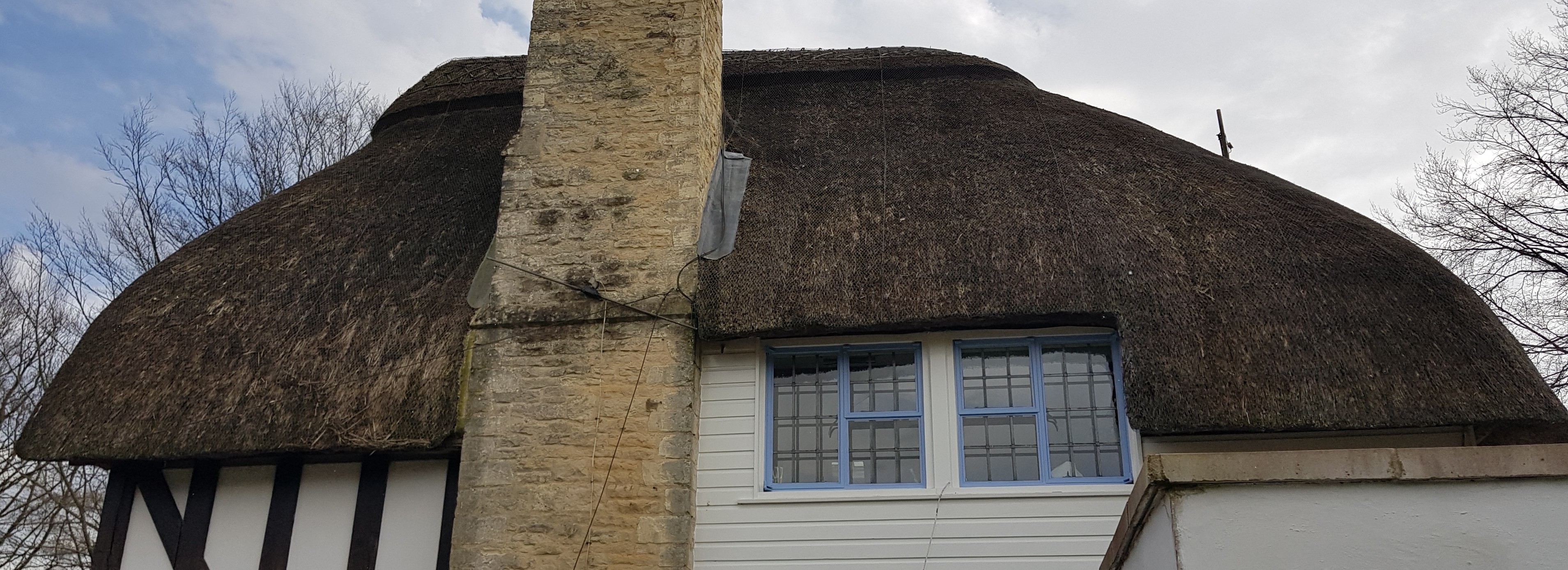
Although the impression that tourists and city-dwellers have of the countryside is often of some kind of mythical idyllic theme park, the romantic idea that the Cotswolds are the epitome of ‘unspoilt nature’ is a serious mistake. The area got this way through hard work and calculated exploitation of local resources. One disappearing aspect of what is called ‘the built environment’ is the number of thatched houses and other buildings. Typically Cotswold thatched roofs are most commonly created from long wheat straw, which needs expensive and relatively frequent maintenance, and – despite their romantic image – suffer from attacks from pests, such as rats, nesting wasps and even birds, leading to a greater risk of leaks than stone. The local plan makes only a passing reference to thatch, and some formerly thatched buildings have recently converted to stone slates.
As an inhabitant of a thatched house, Arrowsmith laments their loss.
To keep up to date with what´s going on in town, feel free to join our Facebook group by clicking here. To advertise with the magazine check out the Rates & Media Pack – Ciren Scene!
0 comments on “Country Matters by Arrowsmith July 25: To Cap It All…”