

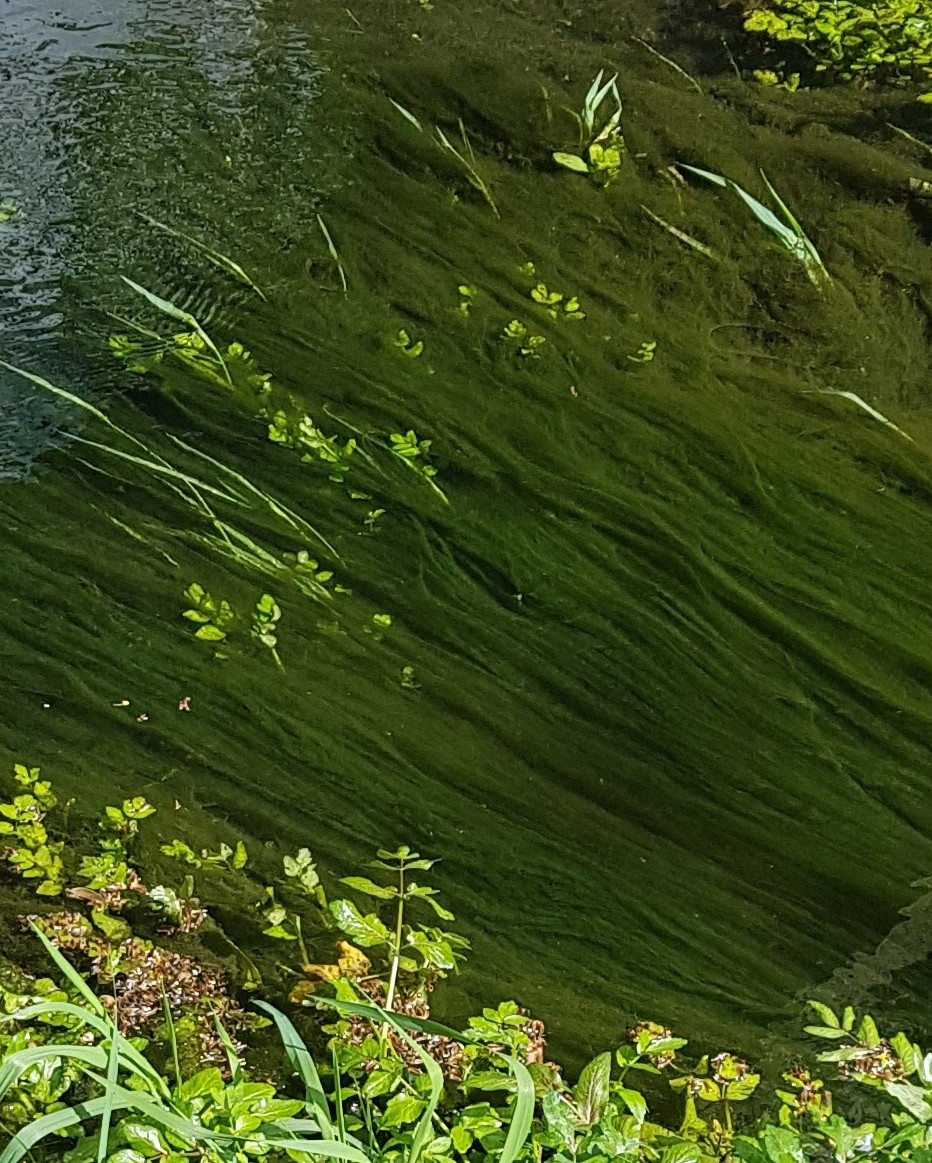
Pictuered Above: Churnweed
At the beginning of March, UK farmers faced a problem caused by the consequences of flooding such as we had seen in past years – like the way Gooseacre became Spitalgate Lake in February 2021.
When land is covered by prolonged flooding, the soil and the plants become starved of oxygen, and anaerobic bacteria flourish, roots beneath the floodwater start to die and rot, and instead of carbon dioxide, methane – a far more damaging ‘greenhouse gas’ – rises into the atmosphere.
Whilst there’s nothing new in methane exuding from rotting vegetation (it was the main component of ‘marsh gas’ which used to catch fire and became known as ‘will o the wisp) it is only recently recognised that a more damaging effect of flooding is the way that the nutrients in the soil of the land leach into watercourses and alter the ‘ecosystem’ of streams and rivers – and ultimately, the seas and oceans.
Of course, that isn’t really the ultimate effect of flooding. There’s that idea that the world’s weather can be completely altered if a butterfly beats its wings in Thailand. That is just an example of a principle which is undoubtedly valid. Systems are easily disrupted by the – apparently – smallest of details. The systems of nature operate on cycles; water, for example, evaporates from the ground and is transpired by plants and trees, then it collects in clouds and falls back to irrigate the land and plants once more, which works perfectly well if nothing else intervenes.
Another cycle, well-known to farmers, is the Nitrogen cycle. There’s a lot of Nitrogen all around us, but few of us ever think of how important it is to our lives, After Carbon, Oxygen and Hydrogen; Nitrogen is the fourth most common element in the human body. We get our supply from what we eat, and don’t notice, as we would notice, if Oxygen or water (Hydrogen and Oxygen) were taken from us. Many of us know that Carbon is important – amongst many other things, we get quite a lot of heat from many forms and compounds of Carbon.
Nitrogen is a vital element for the growth of plants. It begins – in the natural course of events – by entering the soil. It then fertilises plant growth. As it loses ‘independence’ it generates Ammonia, together with Carbon Dioxide. And the plants we – or grazing animals – enjoy are harvested.
As agricultural science has developed, farming has chosen to use industrially produced ways of adding Nitrogen to the land. And the usual way is to synthesise Urea.
Urea does – as seems obvious – form part of urine, but it is neither smelly nor unhygienic (as many ‘organic’ fertilisers can be) and is especially synthesised by combining Ammonia and Carbon dioxide under pressure and heat, then protecting it from releasing ammonia before agricultural use. About 60% of Protected Urea – together with Ammonium Nitrate and Urea enhanced Ammonium Nitrate – which is primarily used as liquid fertiliser = is imported to the UK. Most of that comes from Egypt, although Iran seems to produce 15% of global Urea.
Since March began, the price of Urea has risen. Along with everything else. But because of our flooding through climate change, our farmers must use more nitrogen fertilisers. Despite using Nitrogen fixing crops, we need to replace more Nitrogen.
But go and see the thread algae filling our previously clear, sparkling limestone streams. See it clogging the Churn in the Abbey Grounds. Leached Nitrogen created this. Killed freshwater fish and fauna. Millais’ painting of Ophelia couldn’t survive the outcome of war in the Middle East. It seems possible that many UK farmers face hard times exacerbated by Trump’s adventure in Iran.
To keep up to date with what´s going on in town, feel free to join our Facebook group by clicking here. To advertise with the magazine check out the Rates & Media Pack – Ciren Scene!
0 comments on “Country Matters by Arrowsmith, May 2026: Your Ear or Harmonium Night Rate?”