

Snapshots of Local History
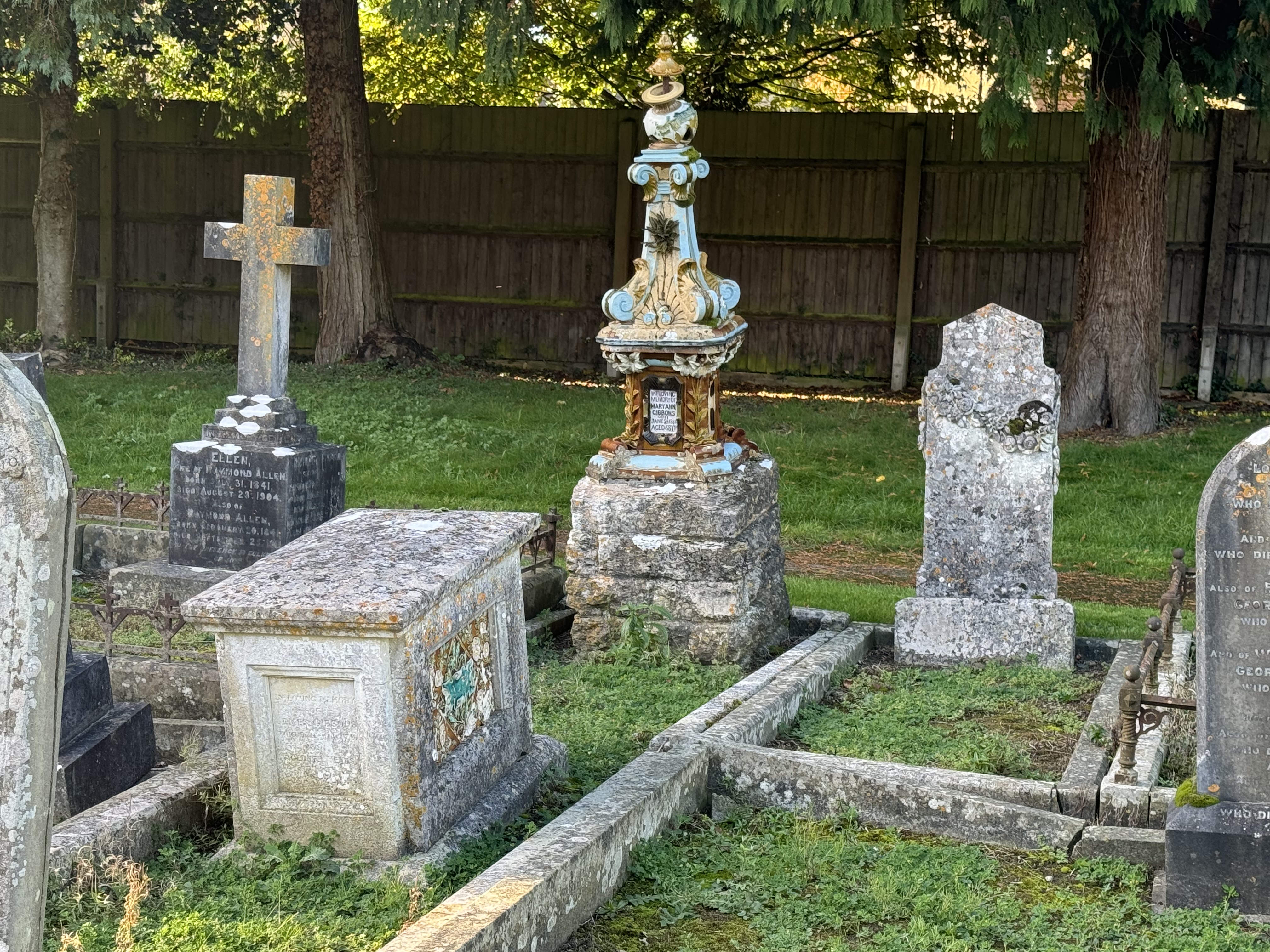
Pictured above: The Gibbons family grave plot. Photo courtesy Robert Heaven
With contributions from Cirencester Archaeological & Historical Society, Cirencester Civic Society, members & friends
This third in a short series of Snapshots seeking historic information available by visiting and studying Cirencester’s burial grounds takes a look at one of the most interesting and artistic local families whose intriguing story deserves to be better known.
For the Gibbons family, their core centre and point of development was Cirencester even though their origin lay a few miles distant in the village of Oaksey and their later careers were largely centred in Staffordshire.
As a master plasterer and builder, James Gibbons (1812-1891) would have worked in many of the Victorian buildings in the town, especially with the expansion of the suburbs south of Lewis Lane.

He and his wife Mary Ann settled in the town in 1854 and raised their family of eight children: Edward, Albert, Owen, Sarah, Francis, Emmeline, Arthur and Alice. All had strong literary and artistic abilities, with professional careers teaching and designing.
Their artistic talents were recognised and nurtured by attending the Cirencester School of Art, run by Mr James Miller in the Corn Hall, and affiliated with the Science and Art Department, South Kensington. That is a story in itself.
Examples of the work of Edward, Owen and Francis are represented in the art collection begun by Daniel Bingham, and now part of the Daniel Bingham Foundation. One of Owen’s watercolours is currently on display in the Bingham Gallery – the Thames & Severn Canal at Furzen Leaze bridge, dated to 1868.
This same Owen Gibbons (1847-1911) was appointed designer to Maw’s tile manufacturers of Jackfield near Ironbridge in Shropshire in 1876. After ten years he moved to the Brierley Hill area of Staffordshire. A committed teacher, he led classes in the principles of art and techniques of both pottery and glass manufacture.
Francis Gibbons (1852-1918), as did his brothers Albert and Owen, studied at South Kensington Royal College of Art before joining Doulton’s Royal Pottery at Lambeth. He gained further experience in Torquay and at Allen’s Pottery at Broseley, Shropshire. His metier appears to have been for design in plaster.

In 1885 Owen and Francis with their brother-in-law William Hinton, husband of Sarah, combined in partnership and established the art tile factory at Brierley Hill: Gibbons, Hinton & Co. Ltd. They specialised in the manufacture of encaustic, enamelled, mosaic and other tiles in works at Brockmoor, sited close to the canal. William dealt with the business side while Owen and Francis concentrated on design and manufacture.
Many a house and institution across the country will have examples of their combined work, on wall or floor. Seeking them out is a fascinating task, and more information is always welcomed.
As final farewells to an individual, three local family memorials certainly stand out. That to Albert Gibbons (died 1868) was featured in the June Snapshot in CirenScene. Aged 23, he died tragically as a result of drowning while swimming in the Serpentine, despite efforts of his brother Owen to save him.
The design and craftsmanship of the carving on his tomb mirrors that on the tomb of his brother Owen (1847-1911) buried in the Black Country churchyard of Holy Trinity, Wordsley, Staffs.
The memorial to Mary Ann Gibbons is a tribute to the combined talents of her sons and son-in-law. It perhaps merits the epitaph of being the most decorative monument in the cemetery at Chesterton, a colourful pedestal set on a rock-stone foundation. Even in decay it certainly stands out in the non-conformist section of the cemetery.
This is a significant work of moulded majolica and encaustic tiles. “In Loving Memory of Mary Ann Gibbons obit Jany. 5th 1886. Aged 68 yrs.” On the base, the initials ‘F.G. 1889’ would suggest the work of her son, Francis Gibbons.
Sadly Mary Ann spent the last five years of her life in Gloucestershire County Asylum. Flowering lilies adorn the base with neoclassic scrolls and acanthus leaves above, leading the eye up to a funeral urn surrounded by bay leaves.
Family head James Gibbons died in 1891 and his memorial, adjacent to that of his wife, is plain in comparison, but a five-tiled plaque with his initials “J G” set within bay leaves and dog roses continues the family link to the decorative arts.
Of the other two brothers, Edward emigrated to America during the Civil War, returning to teach in Edinburgh School of Art before retiring to Cirencester where he died in 1918. Arthur taught at Brockmoor County School until his death in 1917. A remarkable family.
Linda & David Viner
To keep up to date with what´s going on in town, feel free to join our Facebook group by clicking here. To advertise with the magazine check out the Rates & Media Pack – Ciren Scene!
0 comments on “CAHS Snapshots Aug 26: Gibbons – the Artistic Talents of a Cirencester Family”